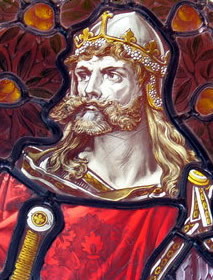
Harald III Sigurdsson Hardråde ~1015–1066
Kung av Norge
Kön: Man Levnadsålder: ≈51
Levnadsbana
| Född | omkring 1015 Bønsnes, Hole, Buskerud, Norway |
| Kung av norge | |
| Sonen Olav Kyrre föds (≈35) | omkring 1050 Norge |
| Död (≈51) | 1066-09-25 Stamford Bridge, England. Dödsorsak: Died in the battle of Stamford Bridge |
Stamford Bridge, East Riding of Yorkshire, Yorkshire and the Humber, England | |
| Begravd | Mariakirken deretter Elgeseter kloster, Trondheim, Trondheim, Sør-Trøndelag, Norway |
Familj
Personanteckningar
Harald Hardråde Sigurdsson (Haraldur Sigurðarson)
Son of Sigurd Halvdansson and Åsta Gudbrandsdóttir, Queen of Norway
Harald Sigurdsson, also known as Harald of Norway (Old Norse: Haraldr Sigurðarson; c. 1015 – 25 September 1066) and given the epithet Hardrada (Old Norse: Harðráði, modern Norwegian: Hardråde, roughly translated as "stern counsel" or "hard ruler") in the sagas, was King of Norway (as Harald III) from 1046 to 1066. In addition, he unsuccessfully claimed the Danish throne until 1064 and the English throne in 1066. Before becoming King, Harald had spent around fifteen years in exile as a mercenary and military commander in Kievan Rus' and of the Varangian Guard in the Byzantine Empire.
Before becoming king, Harald had spent around fifteen years in exile as a mercenary and military commander in Kievan Rus' and of the Varangian Guard in the Byzantine Empire.
Reign: 1046 – 25 September 1066
Married
Married ([1044]) IELIZAVETA Iaroslavna, daughter of IAROSLAV I "Mudriy/the Wise" Vladimirovich Grand Prince of Kiev & his second wife Ingigerd Olafsdottir of Sweden (-after 25 Sep 1066). Snorre records the marriage of King Harald and Elisabeth "called by the Northmen Ellisif" daughter of "King Jarisleif ", specifying in a later passage that "the Swedish king Olaf…was brother of [her] mother". Morkinskinna records the marriage of “Haraldr Sigurdarson” and “King Yaroslav and Queen Ingigerdr…daughter…Elisabeth, the Norsemen call her Ellisif” after Harald´s return from Constantinople. Snorre records that "Queen Ellisif came from the West…with her stepson Olaf and her daughter Ingegerd" after her husband was killed[.
Mistress (1): THORA Thorbergsdatter, daughter of THORBERG Arnesson [Arnung] from Giske & his wife Ragnhild Erlingsdatter ([1020/25-after 1066). Morkinskinna records that King Harald had married “the daughter of Thorbergr Árnason…Thóra”. Snorre names "Thora, daughter of Thorberg Arnason" as mother of King Harald's sons Magnus and Olav, in a later passage clarifying that she was "Fin Arnason's brother's daughter". Her birth date range is estimated on the assumption that her relationship with King Harald started around the time of his accession to the Norwegian throne, corroborated by the fact that her son King Magnus was old enough to have fathered a son before his death in 1069. She gave birth to a son by another relationship, as shown by Snorre recording that her grandson "Hakon…was fostered by Thorer of Steig in Gudbrandsdal, who was a brother of King Magnus by the mother's side", although no indication has yet been found of the identity of Thorer's father. It is assumed that this relationship predated her relationship with King Harald, as it is likely that Thorer was older than his half-brother King Magnus to have been chosen as foster-father for his nephew. According to Europäische Stammtafeln, Thora Thorbergsdotter is identified with Thora who was the wife of Svend II King of Denmark and mother of King Svend's son Magnus. Christiansen considers that this identification is far-fetched, considering Thora's age at the time of the supposed marriage[326]. There appears to be another chronological problem: the proposed consecration of Thora's son Magnus at Rome is best explained if he was King Svend's oldest son, which would place his birth (and therefore his parents' marriage) in the late 1030s. Morkinskinna records that King Harald left “his wife Thora and his daughter Máría” in Orkney when he sailed for England
Project MedLands Norway Kings
HARALD Sigurdson, son of SIGURD Syr King of Ringeringe & his wife Asta Gudbrandsdatter (1015-killed in battle Stamfordbridge 25 Sep 1066, bur Nidaros [Trondheim] St Mary). Snorre names "Guthorm, the eldest, then Gunhild, the next Halfdan, Ingerid and Harald" as the children of Sigurd & his wife[306]. Morkinskinna names (in order) “Gudrødr…Hálfdan…Ingibjorg…Gunnhildr, Haraldr” as the children of “Sigurdr sýr” and his wife “Ásta daughter of Gudbrandr”[307]. The Historia Norwegie names Harald as son of "Siwardus Scroffa rex montanus" & his wife[308]. Morkinskinna refers to “Haraldr Sigurdarson” as uncle of Magnus II King of Norway, but in a later passage recites his descent from “Harald hárfagri” to “Sigurdr hrisi” to “Hálfdan, father of Sigurdr sýr, the father of Haraldr”[309]. Wounded at the battle of Stiklestad in support of his half-brother King Olav II in 1030 when he was 15 years old, he fled to Russia where he served in the army against the Poles and Wends[310]. He made his way to Constantinople, where he served in the imperial army under George Maniakis and was made chief of the imperial guard by Empress Zoe[311]. He was imprisoned on accusations of having defrauded the emperor of treasure, but was able to escape and make his way back to Russia[312]. According to Snorre, he wanted to marry the "beautiful young niece" of Empress Zoe, "carried her away by force" while he made his escape from Constantinople but allowed her ashore "with a good retinue to escort her back to Constantinople"[313]. This story is not corroborated in Byzantine sources. Morkinskinna recounts the same story but refers to the lady as “the maiden Maria” without specifying any relationship to the empress[314]. William of Malmesbury alludes to the same episode when he says that Harald "was exposed to a lion, for having ravished a woman of quality, [and] strangled the beast by the bare strength of his arms"[315]. He was in Jerusalem in 1034[316]. He became Joint King of Norway with his nephew Magnus I in 1046, and succeeded him in 1047 as HARALD III "Hardråde" King of Norway. He founded the city of Oslo in 1048. He defeated Svend II Estridsen King of Denmark at Nissa in 1062, but made peace at Gota in 1064. He claimed to succeed to the throne of England after the death of Edward "the Confessor" King of England, landed in Scotland where he joined forces with Tostig Godwinsson, brother of Harold II King of England. After defeating the Northumbrians at Gate Fulford near York 20 Sep 1066, he and his army were defeated by King Harold's forces at Stamford Bridge 25 Sep 1066, where both he and Tostig were killed. Snorre records that King Harald was fifty years old when he died and that his body was transported to Nidaros and "buried in Mary church which he had built"[317]. Morkinskinna records that King Harald´s body was brought back to Norway by Skuli Tostigson and that he “now lies buried at Elgisetr” where “Archbishop Eysteinn had him delivered”[318].